
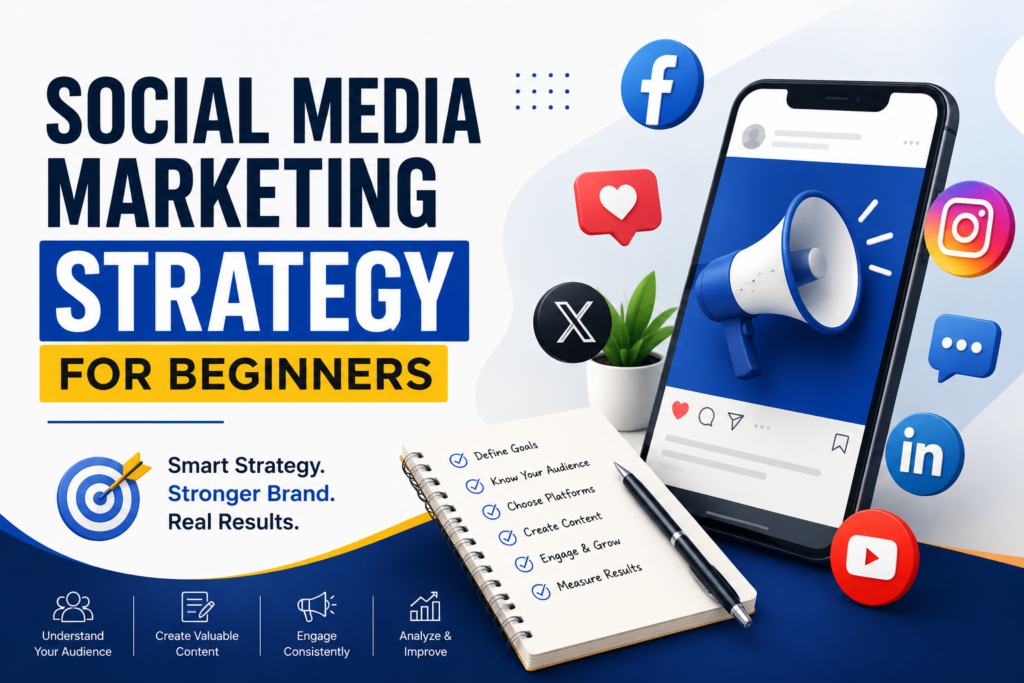
There are 5.2 billion social media users in the world. Your customers are almost certainly among them. But posting randomly and hoping for likes isn’t a strategy — it’s noise. This guide gives you a beginner-proof framework to build a social media presence that actually drives business results (social media marketing strategy)
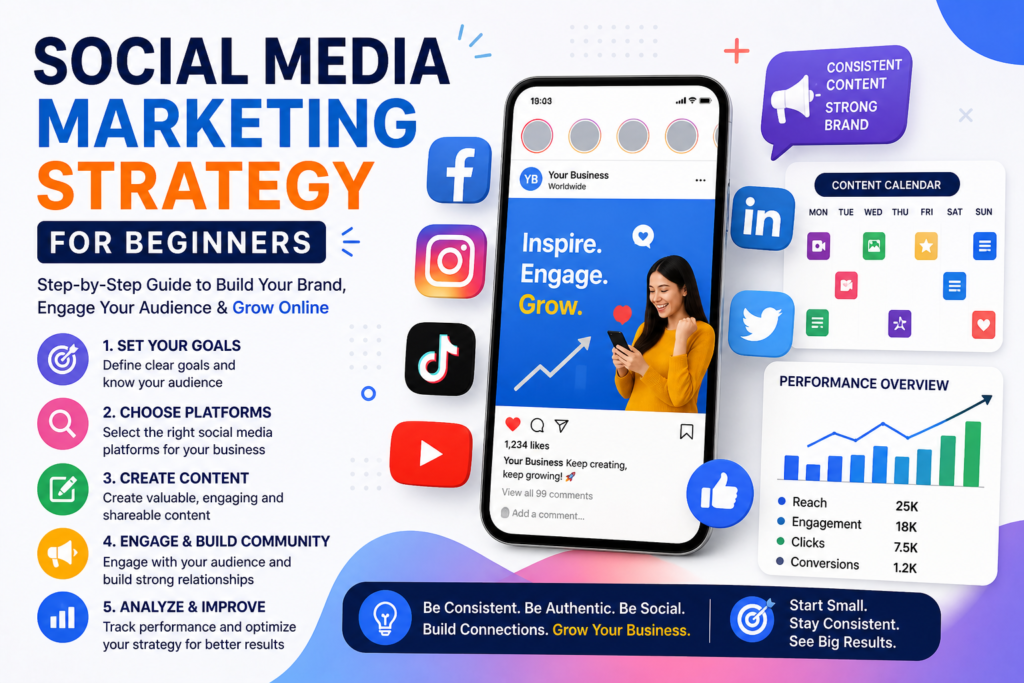
Why Social Media Marketing Works
Social media isn’t just about followers and vanity metrics. Done right, it builds brand awareness, nurtures trust, drives website traffic, and converts strangers into loyal customers — often at a fraction of the cost of paid advertising.
The difference between businesses that thrive on social media and those that don’t usually comes down to one word: strategy. Without a plan, social media becomes a time sink. With one, it becomes one of your most powerful growth channels.
Brand awareness
Put your business in front of new audiences who’ve never heard of you — organically.
Trust building
Consistent, valuable content positions you as an expert people want to buy from.
Community & loyalty
Engaged followers become repeat customers, advocates, and word-of-mouth referrers.
Direct sales
Platforms like Instagram and TikTok now support in-app shopping and direct conversion.
social media marketing strategy
Step 1: Define Your Goals First
Before picking a platform or posting a single piece of content, get crystal clear on what you want social media to accomplish. Vague goals produce vague results( social media marketing strategy).
Awareness goal
Reach new audiences and make them aware your business exists. Measured by impressions, reach, and follower growth.
Engagement goal
Build a community around your brand. Measured by likes, comments, shares, and saves.
Traffic goal
Drive people from social platforms to your website. Measured by link clicks and referral sessions in Google Analytics.
Conversion goal
Turn followers into paying customers. Measured by leads, sales, or sign-ups that originate from social media.
Pick one primary goal per platform. Trying to hit all four at once leads to unfocused content. Most beginners should start with awareness or engagement — conversion comes after you’ve built an audience.
Step 2: Choose the Right Platform
You do not need to be on every platform. Spreading yourself thin across six channels produces mediocre results on all of them. Start with one or two where your audience actually spends time.
Best for: local businesses, older demographics, community groups
Ages 30–60+ 2.9B users B2C & B2B
Best for: visual brands, lifestyle, e-commerce, fashion, food
Ages 18–35 2B users Visual-first
TikTok
Best for: entertainment, product discovery, Gen Z & Millennials
Ages 16–30 1.5B users Video-first
Best for: B2B, professional services, hiring, thought leadership
Ages 25–50 1B users B2B only
X (Twitter)
Best for: news, real-time conversations, tech and media industries
Ages 25–45 550M users Text-driven
Best for: home décor, recipes, fashion, wedding, DIY niches
Majority female 465M users High purchase intent
The platform selection rule: Go where your customers already are — not where you personally prefer to spend time. Survey your existing customers, check where your competitors are active, and choose based on audience fit, not personal comfort.
Step 3: Build Your Content Strategy
Content is the fuel of social media. But not all content is created equal — and producing content without a framework leads to burnout fast. The most sustainable approach is the content mix model.
The 70 / 20 / 10 Content Rule
Value & education
70%
Brand storytelling
20%
Promotional content
10%
70% of your posts should educate, entertain, or genuinely help your audience — no sales pitch. 20% should share your brand story, behind-the-scenes, and team culture. Only 10% should be direct promotions. Most beginners get this backwards, then wonder why nobody engages.
social media marketing strategy
Step 4: Create Content That Stops the Scroll
Every platform’s algorithm rewards content that keeps users on the app. That means your content needs to earn attention in the first 1–2 seconds before someone scrolls past.
High-performing content
✓ Opens with a bold hook or question
✓ Teaches something useful in under 60 seconds
✓ Uses text overlays on video so it works muted
✓ Shows real people, real results, real situations
✓ Has one clear point per post
Low-performing content
✗ Stock photo + generic caption
✗ “Check out our new product!” with no context
✗ Long paragraphs with no visual hook
✗ Inconsistent posting with weeks of silence
✗ No call to action or next step
Content formats that perform well right now
Short-form video
Reels, TikToks, and YouTube Shorts dominate reach on almost every platform right now.
Carousels
Multi-image posts on Instagram and LinkedIn drive high saves and shares — great for tips and lists.
Infographics
Data and how-to visuals get pinned, saved, and shared far more than plain text posts.
Behind-the-scenes
Authentic, unpolished looks at your process build trust and humanize your brand powerfully.
Step 5: Build a Posting Schedule You Can Sustain
Consistency beats frequency every time. Posting five times a day for a week then going silent for a month destroys algorithmic momentum and confuses your audience. Better to post three times a week, every week, indefinitely.
The Minimum Viable Posting Schedule
For beginners: commit to 3 posts per week on your chosen platform. This is enough to stay algorithmically relevant, build a content habit, and grow without overwhelming yourself. Once this feels easy, scale up — not before.
Use a free tool like Buffer, Later, or Meta Business Suite to schedule posts in batches. Set aside two hours on Sunday to create and schedule content for the entire week — this “batch and schedule” approach is how serious content creators stay consistent without burning out.
Step 6: Engage — Don’t Just Broadcast
Social media is a two-way channel. Brands that only push content and never respond to comments, DMs, or mentions are leaving massive engagement and loyalty gains on the table.
- Reply to every comment in the first hour of posting — the algorithm rewards early engagement bursts
- Ask questions in your captions to invite responses rather than passive scrolling
- Engage with others in your niche — comment meaningfully on posts by peers and potential customers
- Use polls and quizzes in Stories and on LinkedIn to drive low-friction interaction
- Reshare user-generated content — when customers post about you, amplify it
Step 7: Track What’s Working
Without measuring results, you’re flying blind. Every platform has a free built-in analytics dashboard — use it weekly to identify what content performs and what falls flat.
Track reach & impressions
How many people are seeing your content? Declining reach is an early signal your content or posting time needs adjustment.
Monitor engagement rate
Likes + comments + shares ÷ reach. A healthy engagement rate (2–5%+) signals the algorithm to show your content to more people.
Watch follower growth
Slow but steady growth is healthy. Sudden spikes followed by drops can signal bot activity or a viral post that attracted the wrong audience.
Measure link clicks & conversions
Use UTM parameters in your bio links to track exactly how much website traffic and revenue originates from each platform.
Common Beginner Mistakes to Avoid
- Trying to be on every platform at once — master one, then expand
- Posting only promotional content — follow the 70/20/10 rule rigorously
- Ignoring your analytics — data tells you what to double down on and what to drop
- Buying followers — fake followers tank your engagement rate and fool no one
- Copying competitors exactly — borrow inspiration, but find your own voice and angle
- Giving up too soon — organic social media growth takes 3–6 months to gain real traction
The 90-day rule: Commit to your strategy for a full 90 days before judging the results. Most beginners quit at 30 days — right before the algorithm starts to reward their consistency. The brands winning on social media are simply the ones who didn’t stop.
Your Strategy Starts With One Post
Social media success isn’t built in a day — it’s built in the daily decisions to show up, add value, and engage authentically. Pick one platform, define one goal, create a content rhythm you can sustain, and measure what matters. The algorithm rewards consistency above everything else. Start simple, stay consistent, and the audience will come.
social media marketing strategy read.