
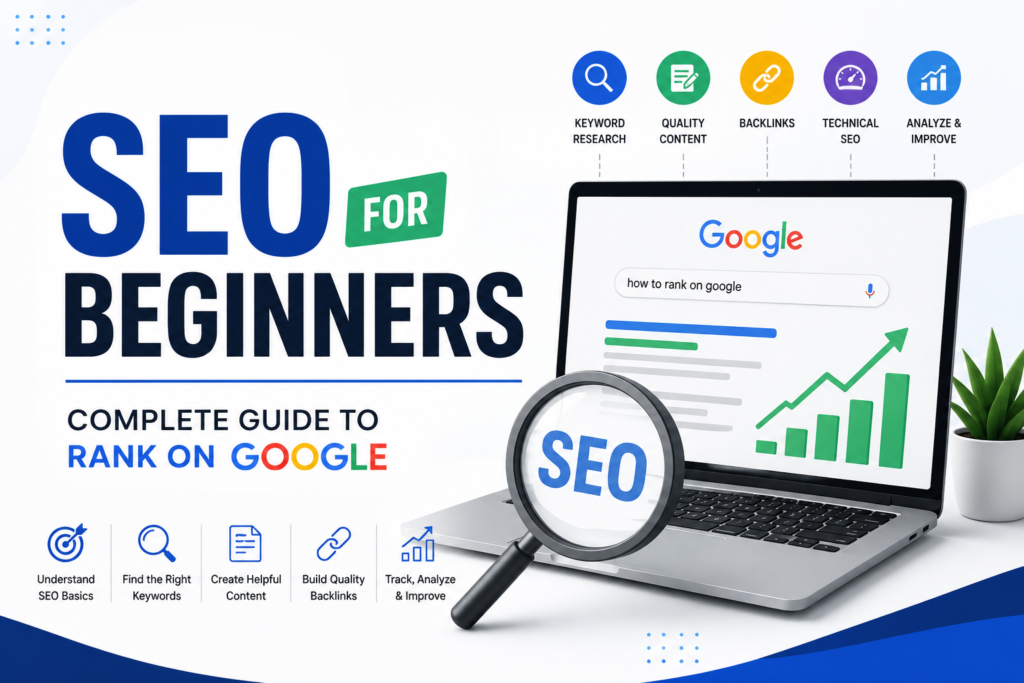
Every day, people type over 8.5 billion searches into Google. Some of those searches are for exactly what you offer. The question is — are you showing up? If not, SEO is the answer. And no, it’s not as complicated as it sounds (SEO for beginners).
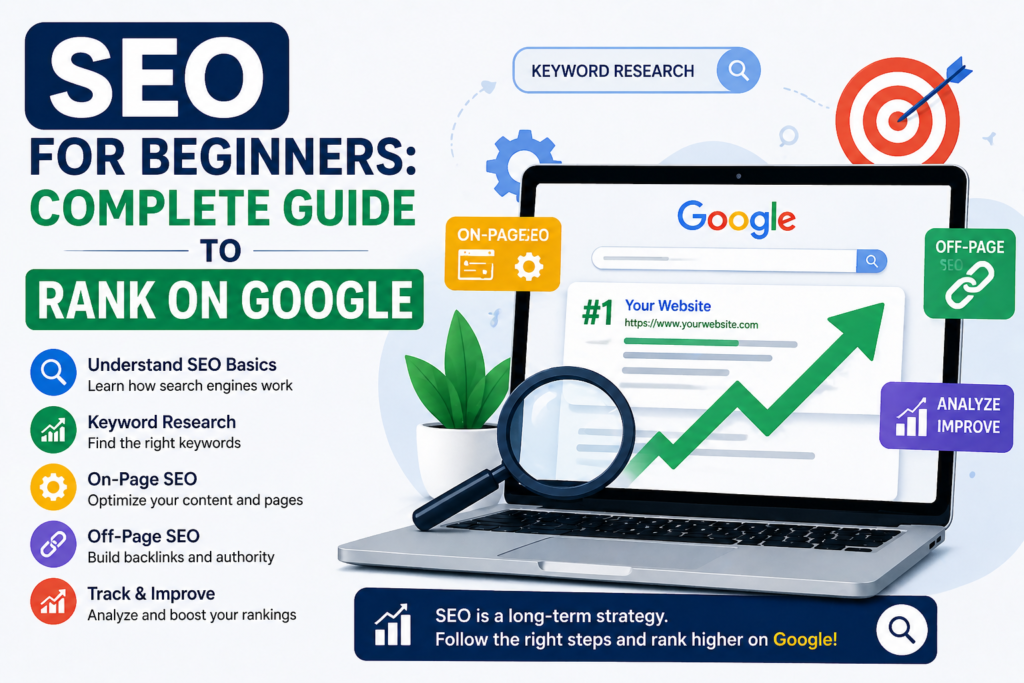
What Is SEO, Exactly?
SEO stands for Search Engine Optimization. In plain English, it’s the practice of improving your website so that Google (and other search engines) rank it higher in search results — without paying for ads.
Think of Google as a librarian. When someone asks a question, the librarian doesn’t guess — it scans millions of web pages and returns the ones it considers most relevant and trustworthy. SEO is your way of signaling to that librarian: “My page is exactly what this person needs.”
The golden rule of SEO: Google wants to show users the most helpful, relevant, and trustworthy result. Everything you do in SEO should serve that goal. (SEO for beginners)
Why SEO Matters for Your Website
Paid ads disappear the moment you stop spending. SEO builds lasting momentum. A page that ranks #1 on Google can drive free traffic for years. Consider this:
- The #1 result on Google gets roughly 27% of all clicks for that search
- 75% of users never scroll past the first page
- Organic search drives more than 50% of all website traffic globally
For small businesses, blogs, startups, or anyone building an online presence — SEO is one of the highest-ROI investments you can make.
The 3 Pillars of SEO Modern SEO rests on three interconnected foundations. Master all three and you’re well ahead of most websites.
On-Page SEO
What’s on your website — keywords, content quality, headings, titles, and user experience.
Off-Page SEO
What happens outside your site — backlinks, social signals, and your domain’s reputation.
Technical SEO
How well your site is built — page speed, mobile-friendliness, crawlability, and structure.
Step 1: Keyword Research — Find What People Search For
Keywords are the foundation of SEO. Before writing a single word, you need to know what terms your target audience is actually typing into Google.
Start by thinking from your audience’s perspective. If you sell handmade candles, someone might search “best soy candles for home” or “natural candles that last long” — not just “candles.” (SEO for beginners)
How to do basic keyword research
Google Autocomplete
Start typing a topic into Google and see what it suggests — these are real searches people make every day.
People Also Ask
Scroll down any search results page. The “People also ask” box is a goldmine of related questions to target.
Free Tools
Use tools like Google Keyword Planner, Ubersuggest, or AnswerThePublic to find search volume and competition.
Focus on Long-Tail Keywords
“Best affordable running shoes for flat feet” is easier to rank for than just “running shoes” — and the visitor is more likely to convert.
Step 2: Create High-Quality Content
Google’s algorithm has one north star: helpful content. With the rise of AI-generated filler on the web, Google is increasingly rewarding content that shows genuine expertise, depth, and value.
When writing content for SEO:
- Answer the search query thoroughly and directly
- Use your target keyword in the title, first paragraph, and naturally throughout
- Structure content with clear headings (H1, H2, H3)
- Aim for comprehensive coverage — go deeper than the current top results
- Include images, examples, and data where relevant
The “10x Content” Rule Don’t just match what’s already ranking — aim to be 10 times more useful. Ask yourself: if someone read only my page, would they have everything they need? If yes, you’re on the right track.
Step 3: Optimize Your On-Page Elements
Even brilliant content can get buried if your on-page elements aren’t set up correctly. These technical details tell Google exactly what your page is about.
Title Tag
This is the blue clickable link shown in search results. Keep it under 60 characters, include your primary keyword, and make it compelling. Example: “SEO for Beginners: How to Rank on Google in 2026”
Meta DescriptionThe short description below the title tag. It doesn’t directly affect rankings but dramatically influences click-through rates. Write 150–160 characters that summarize the page and include a call to action.
URL Structure
Keep URLs short, descriptive, and keyword-rich. Compare: yoursite.com/p=1234 vs yoursite.com/seo-beginners-guide. The second one wins every time.
Internal Linking
Link to other relevant pages on your site. This helps Google understand your site structure and keeps visitors engaged longer — both positive signals.
Step 4: Build Backlinks (Off-Page SEO)
Backlinks — links from other websites pointing to yours — are one of Google’s strongest ranking signals. Think of each backlink as a vote of confidence from another site.
For beginners, the most sustainable way to earn backlinks is simple: create content worth linking to. Original research, comprehensive guides, free tools, and infographics naturally attract links over time.
You can also write guest posts on reputable sites in your niche, get listed in relevant directories, or reach out to journalists covering your topic area.
Step 5: Fix the Technical Basics
Technical SEO ensures Google can actually find, crawl, and index your site. A beautifully written page means nothing if Google can’t access it.
- Page speed: Use Google’s PageSpeed Insights tool. Aim for under 3 seconds load time.
- Mobile friendliness: Google uses mobile-first indexing. Your site must look great on phones.
- HTTPS: A secure site (padlock icon) is a basic ranking factor today.
- XML Sitemap: Submit one via Google Search Console to help Google discover all your pages.
How Long Does SEO Take?
This is the most common beginner question — and the honest answer is: it depends. New websites can take 3–6 months to see meaningful movement. More competitive niches take longer. Established sites with authority can rank new content in days.
The key insight is that SEO is cumulative. Every piece of quality content you publish, every backlink you earn, every technical improvement you make — it all compounds over time. Start now, be consistent, and results will follow.
Quick wins for beginners: Set up Google Search Console (free), submit your sitemap, fix any broken links, and publish one genuinely excellent piece of content targeting a specific long-tail keyword. These four actions alone put you ahead of most SEO for beginners. The Bottom Line
SEO isn’t about gaming the algorithm — it’s about building a website that genuinely deserves to rank. Focus on understanding what your audience searches for, create content that truly helps them, and make sure your site is fast and technically sound. Do that consistently, and Google will reward you. The best time to start was yesterday. The second best time is right now.