
Digital marketing is one of the fastest-growing and most in-demand skill sets in the global job market (Digital Marketing Basics). Whether you’re studying business, communications, design, or anything else — understanding how brands grow online gives you a competitive edge that almost every employer values. This guide covers everything you need to know to start.
What Is Digital Marketing?
Digital marketing is the practice of promoting products, services, or brands through online channels — search engines, social media, email, websites, and more. Unlike traditional marketing (TV, print, billboards), digital marketing is measurable, targetable, and accessible to anyone with an internet connection.
The global digital advertising market is projected to surpass $870 billion by 2026. Companies of every size — from solo entrepreneurs to Fortune 500s — need people who understand how to reach customers online. That’s where you come in.
Measurable
Every click, view, and conversion is tracked. You always know what’s working and what isn’t.
Targetable
Reach specific audiences by age, location, interest, behavior — with laser precision.
Scalable
Start with $0 using organic methods or scale paid ads to millions with the right strategy.
Global reach
A student in any city can market to customers anywhere in the world from a laptop.
The Core Channels of Digital Marketing
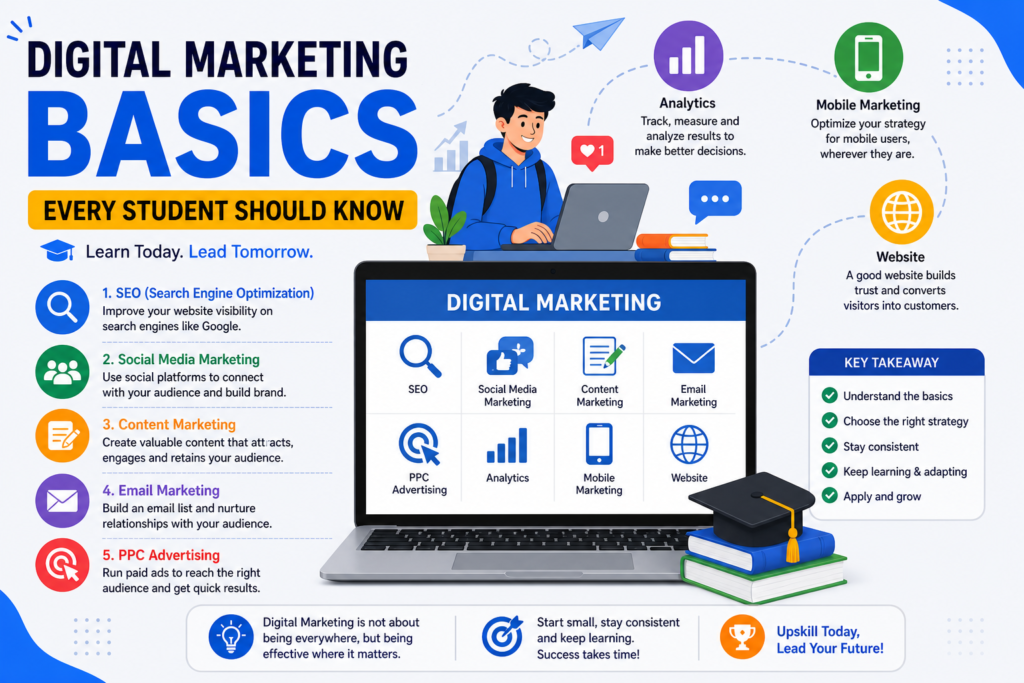
Digital Marketing Basics isn’t one thing — it’s an ecosystem of channels that work best together. Here are the primary ones every student should understand.
SEO
Search Engine Optimization — ranking your website on Google without paying for ads. Builds long-term, compounding traffic.
Free / Organic Long-term
PPC / Paid Ads
Pay-per-click advertising on Google, Meta, or LinkedIn. Instant visibility — you pay only when someone clicks.
Paid Instant results
Social Media
Building brand presence and community on Instagram, TikTok, LinkedIn, Facebook, and other platforms.
Brand building Free + Paid
Email Marketing
Direct communication with subscribers. The highest ROI channel in digital marketing — $42 returned for every $1 spent.
Highest ROI Owned channel
Content Marketing
Creating blogs, videos, podcasts, and guides that attract and educate your audience without selling directly.
Organic Trust-building
Affiliate Marketing
Earning commissions by promoting other brands’ products — or paying others to promote yours.
Performance-based Scalable
Understanding the Marketing Funnel
One of the most fundamental concepts in Digital Marketing is the marketing funnel — the journey a stranger takes from first hearing about a brand to becoming a paying customer. Every piece of marketing content serves a specific stage of this journey.
Awareness
Reach new audiences — blogs, social, ads
Interest
Educate & engage — guides, emails, videos
Consideration
Compare & evaluate — case studies, reviews
Conversion
Buy — landing pages, offers, retargeting
Retention
Loyalty — email, support, community
Great marketers think in funnels. Before creating any content or running any ad, they ask: which stage of the funnel is this for? Understanding this changes how you write, where you distribute, and how you measure success.
Key Concepts Every Student Must Understand
1. Target Audience & Buyer Personas
Before any marketing, you need to know who you’re marketing to. A buyer persona is a semi-fictional profile of your ideal customer — their age, job, goals, pain points, and where they spend time online. Everything in digital marketing flows from knowing your audience deeply.
2. The Difference Between Organic and Paid
Organic marketing means earning traffic and visibility without paying — through SEO, social media posts, or content. Paid marketing means buying visibility through ads. Smart marketers use both: paid for speed, organic for long-term sustainability.
3. KPIs and Metrics That Matter
Digital marketing is data-driven. Every campaign should have measurable Key Performance Indicators (KPIs). Here are the ones you’ll encounter most:
| Metric | What it Measures | Used In |
|---|---|---|
| CTR (Click-Through Rate) | % of viewers who clicked an ad or link | Ads, Email, SEO |
| Conversion Rate | % of visitors who completed a desired action | All channels |
| CPC (Cost Per Click) | How much each ad click costs | Paid Ads |
| CAC (Customer Acquisition Cost) | Total spend ÷ new customers gained | All paid channels |
| ROI / ROAS | Revenue returned per dollar spent on marketing | Paid Ads, overall |
| Bounce Rate | % of visitors who leave without interacting | SEO, Web |
| Open Rate | % of subscribers who opened an email | Email Marketing |
4. A/B Testing
A/B testing (or split testing) means showing two versions of something — an ad, email subject line, or landing page — to different audience segments to see which performs better. It’s how professional marketers make decisions based on data, not guesswork.
5. The Customer Journey
Rarely does someone see one ad and immediately buy. The average customer touches a brand 7–13 times before converting. Understanding this “multi-touch journey” is what separates strategic marketers from people who just post content and hope.
The Most Important Skill in Digital Marketing
It’s not knowing how to run ads or write SEO copy. It’s understanding human psychology — what motivates people to click, read, trust, and buy. Every channel and tactic is just a vehicle. Empathy for your audience is the engine.
In-Demand Digital Marketing Skills for Students
SEO & Content Writing
Understanding how to research keywords, write optimized content, and structure pages for Google is one of the most transferable skills in digital marketing — needed by every type of business.
Google & Meta Ads
Running paid campaigns on Google and Facebook/Instagram is a core skill for most marketing roles. Even basic proficiency here is a significant differentiator when applying for jobs.
Analytics & Data Interpretation
Google Analytics 4, Search Console, and platform dashboards — the ability to read data and extract insights is what separates junior marketers from those who get promoted fast.
Email Marketing Tools
Hands-on experience with Mailchimp, Klaviyo, or ConvertKit — building sequences, segmenting lists, and writing copy — is a practical skill that’s immediately useful in almost any marketing job.
Social Media Content Creation
Creating Reels, carousels, and short-form video content is now a core marketing function. Comfort with Canva, CapCut, or even just your phone’s camera is a real asset.
Copywriting
Writing persuasive, clear, and audience-specific copy — for ads, emails, landing pages, and social — is the most universally valuable skill across every digital marketing role.
Career Paths in Digital Marketing
Digital marketing offers a wide range of career paths depending on your strengths — creative, analytical, strategic, or technical. Here’s a look at roles you can grow into.
SEO Specialist
₹3–8 LPA entry level
Optimizes websites to rank on search engines. Blend of technical, analytical, and writing skills.
Social Media Manager
₹2.5–6 LPA entry level
Manages brand presence across platforms. Requires creativity, consistency, and community skills.
PPC / Paid Ads Specialist
₹4–10 LPA entry level
Manages Google and Meta ad campaigns. Highly data-driven and in strong demand.
Content Marketer
₹3–7 LPA entry level
Creates blogs, videos, and guides. Perfect for strong writers who love research and storytelling.
Email Marketing Specialist
₹3–8 LPA entry level
Builds and manages email campaigns. Combines copywriting, segmentation, and analytics.
Digital Marketing Manager
₹8–18 LPA mid level
Oversees all digital channels and strategy. The destination role after mastering one or two specializations.
Free Certifications to Get Started
You don’t need an expensive course to get credible digital marketing credentials. These free certifications are recognized by employers and give you real, practical skills.
Google Digital Marketing & E-commerce Certificate Free
Offered via Google Career Certificates on Coursera. Covers SEO, email, analytics, ads, and e-commerce fundamentals. Highly employer-recognized.
Google Analytics Certification Free
From Google Skillshop. Teaches GA4 — the industry standard analytics tool. A must-have for any marketing resume.
Meta Social Media Marketing Certificate Free
Covers Facebook and Instagram marketing, advertising, and content strategy. Offered via Coursera’s Meta track.
HubSpot Inbound Marketing Certification Free
Teaches the inbound methodology — attract, convert, close, delight. Widely respected in B2B marketing roles.
SEMrush SEO Fundamentals Certification Free
Practical SEO training from one of the industry’s leading tools. Signals to employers you understand real-world search marketing.
Student advantage: You don’t need work experience to learn digital marketing — you can practice on your own social profiles, a personal blog, or by helping a local business for free. Hands-on experience, even self-initiated, is far more impressive on a resume than certifications alone.
How to Start Learning Today (For Free)
- Start a personal blog — practice SEO, content writing, and Google Analytics in real conditions
- Run a small Instagram or LinkedIn page on a topic you care about — learn social media by doing
- Follow industry blogs: Neil Patel, Search Engine Journal, HubSpot Blog, Backlinko
- Offer to help a local business with their social media or Google listing for free — real experience beats any course
- Set up a free Google Ads account and explore the interface without spending — familiarity alone is valuable
- Subscribe to marketing newsletters like Marketing Brew, Growth.Design, or The Hustle to stay current
The Best Time to Learn This Was Yesterday
Every year you wait is a year someone else is building the portfolio, the certifications, and the hands-on experience that employers pay for. Digital marketing skills compound just like investments — start small, stay consistent, and in 12 months you’ll have a body of work that speaks for itself.
Your Digital Marketing Journey Starts Now
You don’t need a marketing degree to become a great digital marketer. You need curiosity, consistency, and a willingness to learn by doing. Pick one channel — SEO, social media, email, or paid ads — and go deep before going broad. Get one free certification, start one real project, and take one piece of measurable action this week. The students who understand digital marketing (Digital Marketing Basics) don’t just get jobs — they create opportunities.